Auto Plating Lines for High-Volume Manufacturing
Auto Plating Lines for High-Volume Manufacturing
In short:
Robotic Hot Dip Galvanizing in auto plating lines uses automation and robotics to coat metal parts with zinc for strong corrosion protection. It improves consistency, reduces manual errors, and supports high-volume production. This system is widely used in industries that need durable, uniform coatings with minimal defects and high efficiency.
Introduction
In Indian manufacturing, surface protection is a major challenge. Industries deal with corrosion, uneven coating, and inconsistent quality. Manual galvanizing processes often lead to defects, rework, and higher costs. As production volumes increase, these issues become more serious.
This is where Robotic Hot Dip Galvanizing and automated plating lines play an important role. These systems combine robotics, process control, and material handling to deliver consistent coating quality. They also help industries meet strict durability and compliance standards.
For manufacturers producing large volumes of components, automation is no longer optional. It is necessary for maintaining quality, reducing waste, and improving productivity.
What is Robotic Hot Dip Galvanizing?
Robotic Hot Dip Galvanizing is an advanced surface treatment process where metal components are dipped into molten zinc using automated robotic systems. The zinc forms a protective layer that prevents rust and corrosion.
In traditional galvanizing, workers manually handle parts. This can cause uneven coating and safety risks. In robotic systems, every step is controlled and repeatable.
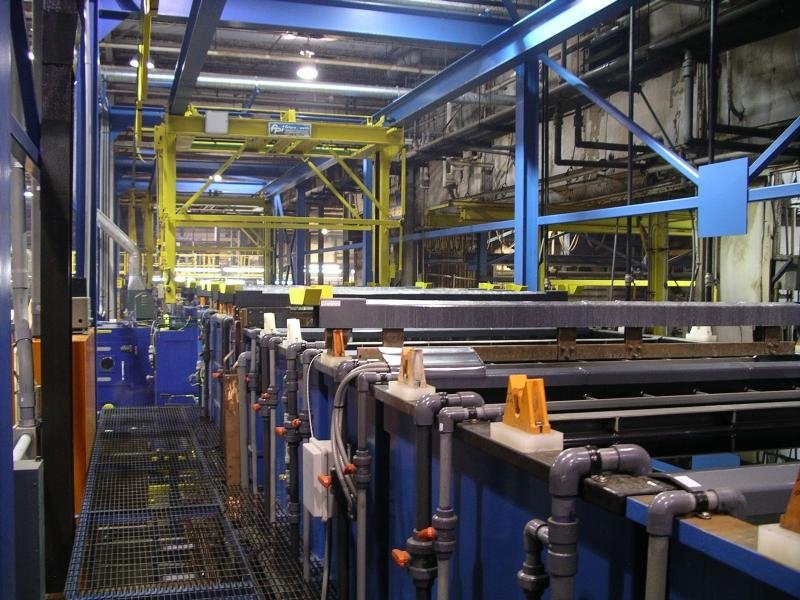
Auto plating lines integrate this galvanizing process with conveyors, hoists, and programmable controls. This ensures that each component goes through the same treatment cycle without variation.
The result is a uniform, high-quality coating suitable for demanding industrial applications.
How the System Works (Step-by-Step)
Robotic Hot Dip Galvanizing in auto plating lines follows a structured and automated process:
1. Loading of Components
Parts are loaded onto racks or fixtures. Robots or automated systems handle positioning.
2. Pre-Treatment Cleaning
Components pass through cleaning stages like degreasing and acid pickling to remove dirt, oil, and rust.
3. Fluxing Process
A flux solution is applied to prepare the surface for better zinc bonding.
4. Drying Stage
Parts are dried to ensure proper adhesion during galvanizing.
5. Hot Dip Galvanizing
Robots dip the components into molten zinc at controlled temperatures. This creates a strong metallurgical bond.
6. Cooling and Solidification
The coated parts are cooled, allowing the zinc layer to solidify evenly.
7. Inspection and Unloading
Automated systems check coating quality before unloading the finished parts.
Each step is controlled by PLC systems, ensuring accuracy, repeatability, and minimal human intervention.
Let’s Build the Right Solution Together
Whether you’re exploring ideas or planning a project, our team is here to listen, guide, and deliver solutions that fit your exact requirements.
Benefits & Performance Advantages
Robotic Hot Dip Galvanizing offers several advantages for high-volume manufacturing:
- Improved coating quality and uniform thickness
- Strong corrosion resistance for long-term durability
- Reduced manual handling and human errors
- Higher production speed and efficiency
- Consistent results across large batches
- Better worker safety and reduced exposure to hazards
- Lower rework and rejection rates
- Long-term cost savings through automation
These benefits make it ideal for industries that require precision and reliability.
Practical Industrial Applications
Robotic Hot Dip Galvanizing is widely used across multiple industries:
Automotive Industry
Used for chassis parts, fasteners, and structural components that need corrosion protection. Learn more about applications in the automotive sector through automotive surface treatment solutions.
Aerospace Industry
Critical components require high-quality coatings for safety and performance. Explore more at aerospace surface treatment systems.
Medical Devices
Used for equipment that requires durability and resistance to environmental conditions. See solutions at medical surface treatment applications.
Fasteners Industry
Bolts, nuts, and screws benefit from uniform zinc coating. Detailed solutions are available at fasteners surface treatment systems.
Household & Consumer Products
Appliances and hardware parts require long-lasting finishes. Learn more at household surface treatment solutions.
General Manufacturing
Widely used for industrial components, structures, and fabricated parts requiring corrosion resistance.
Expert Insight: Suntech Energreen Perspective
Suntech Energreen designs and delivers advanced surface treatment systems tailored for industrial needs. Their approach focuses on engineering precision and automation.
They offer custom-built auto plating lines with integrated Robotic Hot Dip Galvanizing systems. Each solution is designed based on production capacity, component type, and industry requirements.
Their systems include:
- PLC-controlled automation for process consistency
- Robotic handling for improved accuracy
- Energy-efficient designs for cost savings
- End-to-end project support from design to installation
With experience across multiple industries, Suntech Energreen has successfully delivered projects across India. Their execution capability can be explored through project references.
For a complete range of solutions, manufacturers can review surface treatment products.
Conclusion
Robotic Hot Dip Galvanizing is a key solution for modern high-volume manufacturing. It ensures consistent coating quality, improves productivity, and reduces operational risks. As industries in India continue to scale, automated plating lines are becoming essential for maintaining global standards.
Manufacturers looking to improve durability and efficiency should consider investing in advanced surface treatment systems. These solutions not only enhance product life but also reduce long-term costs.
To explore suitable solutions or discuss project requirements, visit contact Suntech Energreen for expert consultation.
Frequently Asked Questions (FAQ)
1. How does Robotic Hot Dip Galvanizing improve quality?
It ensures consistent dipping time, temperature control, and handling. This results in uniform coating thickness and fewer defects compared to manual processes.
2. Is galvanizing necessary for corrosion protection?
Yes. Hot dip galvanizing provides a strong zinc layer that protects metal from rust, especially in harsh environments.
3. Which industries benefit most from automated plating lines?
Automotive, aerospace, fasteners, and general manufacturing industries benefit the most due to their high production volumes and quality requirements.
4. Does automation reduce operational costs?
Yes. Automation reduces labor, minimizes errors, and improves efficiency, leading to long-term cost savings.
5. Can systems be customized for specific products?
Yes. Modern plating lines are designed based on product size, material, and production capacity.
Let’s Talk About Your Needs
Let’s talk about what you’re looking for. Share your requirements with us, and our team will guide you with the right solutions and clear answers.