What Is a Medical Polishing Lining Plant and How Does It Work?
What Is a Medical Polishing Lining Plant and How Does It Work?
In short:
A medical polishing line plant uses mechanical and electropolishing techniques to remove micro-roughness from stainless steel and medical-grade metal surfaces. This process delivers a hygienic, corrosion-resistant, mirror finish required for surgical instruments and medical devices. Suntech Energreen designs and manufactures these plants for manufacturers who need consistent, batch-after-batch surface quality that meets international medical hygiene standards.
Introduction
If you manufacture surgical instruments, implants, or medical-grade components, surface finish isn’t cosmetic — it’s a compliance requirement. A rough or inconsistent surface can hold bacteria, cause corrosion, and lead to instrument rejection during quality audits. Many manufacturers struggle with manual polishing because it’s slow, inconsistent, and hard to scale.
This is exactly where a medical polishing lining plant changes the game. It automates surface finishing so every batch comes out with the same mirror-smooth, hygienic surface — every single time. Suntech Energreen builds these systems for manufacturers across India who need reliable, repeatable finishing without depending on manual skill levels. Whether you’re producing surgical scissors, forceps, implants, or diagnostic equipment components, a properly engineered polishing line solves your consistency and hygiene problem at the source.
What Is a Medical Polishing Lining Plant?
A medical polishing lining plant is a dedicated industrial system built to perform controlled surface finishing on medical-grade metals — mostly stainless steel, titanium, and other biocompatible alloys. It combines mechanical polishing stations with electropolishing tanks to strip away microscopic burrs, oxide layers, and surface irregularities left behind from machining or fabrication.
The goal isn’t just shine. It’s about achieving a specific surface roughness (Ra value) that medical standards demand — low enough that bacteria and contaminants have nowhere to cling to.
Unlike general industrial polishing, medical polishing lines are built with tighter process controls, cleaner chemistry, and validation-friendly documentation. This is because the finished parts often go straight into surgical use or implantation, where any surface defect is a direct risk.
Suntech Energreen’s plants are engineered specifically around these medical-grade requirements, not adapted from generic metal finishing lines.
How a Medical Polishing Line Plant Works
- Incoming Inspection- Raw or semi-finished medical components are checked for material grade, dimensional accuracy, and existing surface condition before entering the line.
- Degreasing and Cleaning— Parts pass through a degreasing stage to remove oils, cutting fluids, and machining residue that would otherwise interfere with polishing.
- Mechanical Pre-Polishing— Abrasive belts or automated buffing stations remove visible scratches, burrs, and tool marks, preparing the surface for fine finishing.
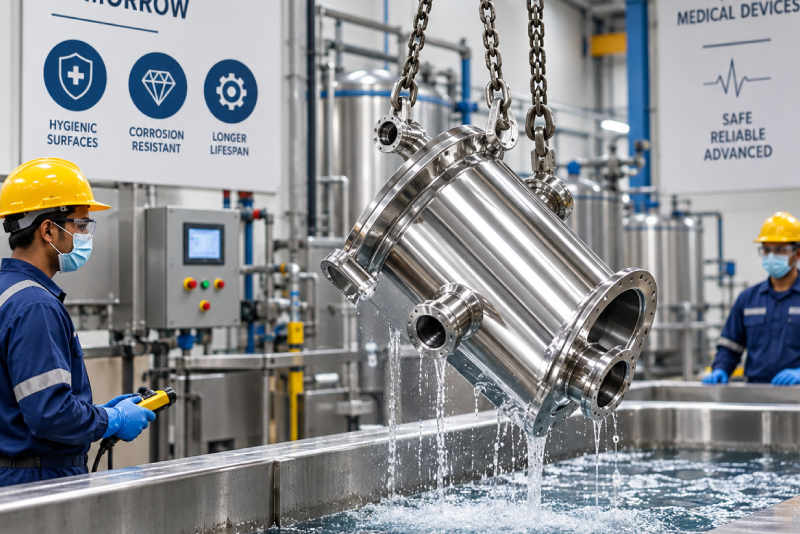
- Electropolishing — Parts are submerged in an electrolyte bath where controlled electrochemical action removes microscopic surface layers, achieving the smooth, mirror-like finish medical instruments require.
- Rinsing and Neutralization— Multi-stage rinsing removes all chemical residue, followed by neutralization to make sure no reactive traces remain on the surface.
- Passivation- This step enhances corrosion resistance by forming a protective oxide layer, critical for instruments that face repeated sterilization cycles.
- Drying and Quality Inspection — Final parts are dried and checked for surface roughness, visual defects, and consistency using precision measurement tools.
- Packing for Dispatch — Approved parts are packed in contamination-controlled conditions, ready for sterilization or direct use in medical device assembly.
Let’s Build the Right Solution Together
Whether you’re exploring ideas or planning a project, our team is here to listen, guide, and deliver solutions that fit your exact requirements.
Key Benefits of a Medical Polishing Lining Plant
Consistent Surface Finish — Every batch achieves the same Ra value, removing the variation that comes with manual polishing.
Improved Hygiene Compliance — Smooth, pore-free surfaces reduce bacterial adhesion, helping instruments pass strict sterilization and hygiene audits.
Better Corrosion Resistance — Electropolishing and passivation together extend instrument life, especially under repeated autoclave cycles.
Higher Production Throughput — Automated lines process far more units per shift compared to manual buffing teams.
Reduced Rejection Rates — Controlled process parameters mean fewer surface-related quality failures during final inspection.
Lower Long-Term Labor Dependency — Automation reduces reliance on highly skilled manual polishers, who are increasingly hard to retain.
Documentation-Ready Process Data — Modern plants log process parameters, useful for quality audits and ISO/medical device compliance records.
Services / Offerings
Suntech Energreen offers complete solutions built around medical-grade surface finishing needs:
Medical Polishing Lining Plant Manufacturing — End-to-end design, fabrication, and installation of automated polishing lines built specifically for surgical instrument and medical device manufacturers.
Medical Surface Treatment Solutions — Complete surface treatment process design covering degreasing, electropolishing, passivation, and finishing validation for medical-grade components.
Both offerings are engineered around real production needs — not generic templates — so the plant fits your product range, batch sizes, and compliance requirements from day one.
Why Location Matters
Manufacturing medical instruments in India comes with its own set of sourcing, service, and compliance challenges — and having a local equipment partner makes a real difference.
Suntech Energreen is based out of Tamil Nadu, serving manufacturers across Vellore, Chennai, and other industrial hubs in India. Being locally accessible means faster response times for installation support, spare parts, and troubleshooting — you’re not waiting weeks for an overseas technician.
Local presence also means better understanding of India-specific power supply variations, water quality for rinsing stages, and regional compliance expectations that affect plant design.
For manufacturers scaling up medical device production in India, working with a plant builder who understands the local industrial ecosystem — not just the technical specs — saves real time and money over the plant’s operating life.
Why Choose Suntech Energreen
Medical-Grade Engineering Focus — Plants are designed specifically for medical surface finishing standards, not repurposed industrial equipment.
End-to-End Process Ownership — From degreasing to passivation, every stage is engineered and integrated as one complete system.
Proven Manufacturing Experience — Years of building surface treatment plants across electroplating, phosphating, and medical finishing categories.
Customized Line Configuration — Plants are sized and configured around your actual batch volumes and component types, not one-size-fits-all.
Reliable After-Sales Support — Local technical support for installation, commissioning, and ongoing maintenance.
Compliance-Ready Process Design — Systems built with documentation and repeatability in mind, supporting your quality audit requirements.
If you’re planning to set up or upgrade a medical polishing lining plant, Suntech Energreen can guide you from concept to commissioning. Get in touch to discuss your production requirements.
Conclusion
A medical polishing lining plant isn’t just about achieving shine — it’s about hygiene, compliance, and consistency that directly impacts patient safety. From mechanical pre-polishing to electropolishing and passivation, every stage plays a role in delivering surgical-grade surface quality at scale.
Suntech Energreen builds these plants specifically for medical-grade manufacturing needs, backed by local support across Tamil Nadu and beyond. If you’re ready to eliminate manual polishing inconsistency and scale up production reliably, visit Suntech Energreen or contact the team to start planning your plant setup.
Frequently Asked Questions (FAQ)
What is a medical polishing lining plant used for?
It’s used to give medical instruments and device components a smooth, hygienic, mirror-like surface finish, removing microscopic roughness that can harbor bacteria or cause corrosion.
What is the difference between mechanical polishing and electropolishing?
Mechanical polishing physically removes surface material using abrasives, while electropolishing uses controlled electrochemical action to remove a microscopic layer, achieving a finer, more uniform finish.
Why is surface roughness important for medical instruments?
Lower surface roughness reduces bacterial adhesion and improves cleanability, which is critical for instruments that undergo repeated sterilization and direct patient contact.
Can a medical polishing plant handle different types of instruments?
Yes, well-designed plants can be configured to handle surgical instruments, implants, and other medical-grade components with adjustable process parameters for each material type.
How does passivation improve instrument durability?
Passivation forms a protective oxide layer on stainless steel surfaces, significantly improving corrosion resistance and extending instrument lifespan under repeated autoclave cycles.
Let’s Talk About Your Needs
Let’s talk about what you’re looking for. Share your requirements with us, and our team will guide you with the right solutions and clear answers.