Challenges in Traditional Hot Dip Galvanizing and Robotic Solutions
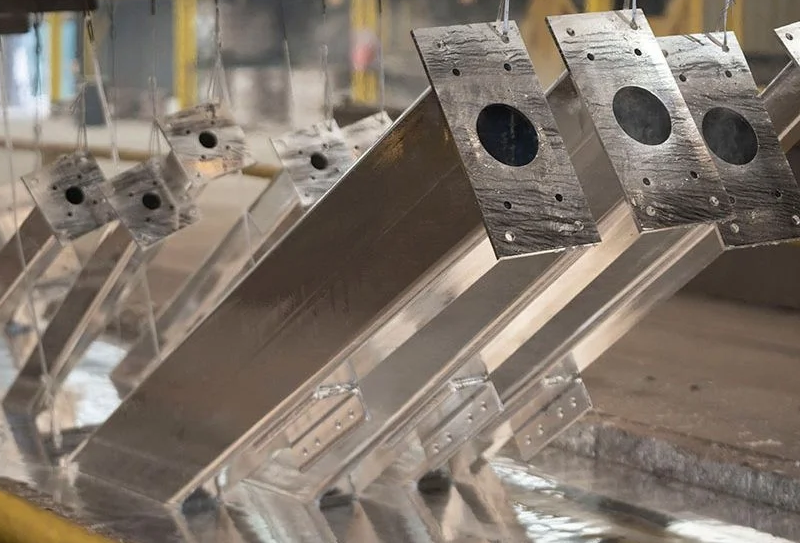
Challenges in Traditional Hot Dip Galvanizing and Robotic Solutions
In short:
Traditional Hot Dip Galvanizing faces challenges like inconsistent coating thickness, manual errors, safety risks, and limited process control. Robotic Hot Dip Galvanizing solves these issues by automating material handling, controlling immersion time, and ensuring uniform zinc coating. This results in better corrosion protection, improved productivity, and consistent quality, making it ideal for modern industrial manufacturing.
Introduction
Steel is widely used in infrastructure, automotive, and industrial manufacturing. However, corrosion remains one of the biggest challenges for steel components.
Hot Dip Galvanizing is a proven method to protect steel from rust. It creates a zinc coating that acts as a barrier against environmental damage.
But traditional galvanizing methods often rely on manual operations. This leads to inconsistent coating thickness, uneven quality, and safety concerns.
In India’s growing industrial sector, manufacturers are under pressure to improve quality, reduce costs, and meet global standards. Manual processes are no longer sufficient for large-scale production.
This is where Robotic Hot Dip Galvanizing becomes important. It brings automation, precision, and reliability to the galvanizing process, solving many limitations of traditional systems.
What Is Robotic Hot Dip Galvanizing?
Robotic Hot Dip Galvanizing is an automated version of the conventional galvanizing process. It uses robotic systems to handle steel components during the coating process.
In both traditional and robotic methods, steel is dipped into molten zinc to form a protective coating. The difference lies in how the process is controlled.
In robotic systems:
- Robots handle material movement
- Sensors monitor process conditions
- PLC systems control timing and temperature
This level of automation ensures that every component is processed under the same conditions.
Modern surface treatment plants use such automated technologies to improve consistency and performance. These systems are part of advanced industrial solutions, like those found in Suntech Energreen’s product portfolio.
How the System Works (Step-by-Step)
Robotic Hot Dip Galvanizing follows a structured and automated process.
1. Degreasing
Steel parts are cleaned to remove oil and contaminants.
2. Pickling
Acid treatment removes rust and scale from the surface.
3. Fluxing
Flux is applied to prevent oxidation before galvanizing.
4. Robotic Transfer
Robots move components between tanks safely and efficiently.
5. Zinc Bath Immersion
Steel parts are dipped into molten zinc at controlled temperatures.
6. Controlled Withdrawal
Robots ensure uniform withdrawal speed, which affects coating thickness.
7. Cooling and Inspection
The coated components are cooled and checked for quality.
Automation ensures each step is consistent, reducing variability and improving results.
Let’s Build the Right Solution Together
Whether you’re exploring ideas or planning a project, our team is here to listen, guide, and deliver solutions that fit your exact requirements.
Challenges in Traditional Hot Dip Galvanizing
Traditional galvanizing methods face several operational and quality-related challenges.
- Inconsistent coating thickness: Manual dipping leads to uneven zinc layers
- High dependency on operator skill: Results vary based on worker experience
- Safety risks: Workers are exposed to high temperatures and hazardous conditions
- Limited process control: Difficult to maintain uniform timing and temperature
- Lower productivity: Manual handling slows down production
- Higher rejection rates: Defects due to uneven coating increase rework
These challenges make it difficult for manufacturers to maintain quality in large-scale operations.
Benefits and Performance Advantages of Robotic Solutions
Robotic Hot Dip Galvanizing addresses the limitations of traditional systems.
- Improved coating quality: Uniform zinc thickness across all components
- Better corrosion resistance: Consistent coating enhances durability
- Accurate process control: Automation ensures precise timing and temperature
- Reduced manual errors: Less dependence on human intervention
- Higher productivity: Faster processing and increased output
- Enhanced worker safety: Robots handle hazardous tasks
- Long-term cost efficiency: Lower rejection rates and reduced maintenance
These advantages make robotic systems a preferred choice for modern industries.
Practical Industrial Applications
Robotic Hot Dip Galvanizing is widely used in industries that require consistent quality and corrosion protection.
Automotive Industry
Used for chassis components, brackets, and structural parts. Similar automated solutions are applied in automotive surface treatment systems.
Aerospace Industry
High precision and reliability are essential. Advanced coating processes align with aerospace surface treatment technologies.
Medical Devices
Medical equipment requires durable and hygienic finishes. Automated systems are used in medical surface treatment applications.
Fasteners Industry
Bolts and nuts need uniform coating for corrosion protection. These solutions are similar to fastener surface treatment systems.
Household and Consumer Products
Appliances and metal fittings require long-lasting coatings. This aligns with household surface treatment technologies.
General Manufacturing and Infrastructure
Large structures, towers, and industrial components benefit from robotic galvanizing due to improved durability and consistency.
Expert Insight: Suntech Energreen Perspective
Industrial manufacturers need reliable and scalable surface treatment solutions.
Suntech Energreen provides custom-engineered surface treatment plants designed for modern industrial needs. These systems integrate robotics, automation, and advanced process controls.
The company focuses on:
- Automated and PLC-controlled systems
- High process consistency and reliability
- Scalable solutions for different industries
Suntech Energreen has extensive experience across sectors such as automotive, infrastructure, aerospace, and manufacturing.
The company offers end-to-end support, including design, manufacturing, installation, and commissioning.
Real-world project implementations can be explored through Suntech Energreen’s project references, showcasing proven expertise in India.
Conclusion
Traditional Hot Dip Galvanizing has been widely used for corrosion protection. However, manual processes come with limitations such as inconsistent quality, safety risks, and lower productivity.
Robotic Hot Dip Galvanizing addresses these challenges by introducing automation and process control. It ensures uniform coating, improves efficiency, and enhances worker safety.
For manufacturers aiming to meet modern quality standards and handle large-scale production, robotic solutions offer a clear advantage.
As industries continue to adopt automation, robotic galvanizing is becoming an essential part of advanced surface treatment systems.
To upgrade your operations, you can explore Suntech Energreen’s surface treatment solutions or contact Suntech Energreen for project consultation.
Frequently Asked Questions (FAQ)
What are the main problems in traditional galvanizing?
Traditional galvanizing faces issues like inconsistent coating thickness, manual errors, safety risks, and low productivity. These problems affect quality and increase costs.
How does robotic galvanizing improve quality?
Robotic systems control immersion time, temperature, and handling. This ensures uniform coating thickness and reduces defects.
Is robotic galvanizing safer than manual methods?
Yes. Robots handle high-temperature processes and heavy components, reducing risks for workers.
Can robotic systems handle large-scale production?
Yes. Robotic galvanizing is designed for high-volume production with consistent quality.
Why is consistent coating thickness important?
Uniform coating ensures better corrosion protection and longer service life of steel components.
Let’s Talk About Your Needs
Let’s talk about what you’re looking for. Share your requirements with us, and our team will guide you with the right solutions and clear answers.